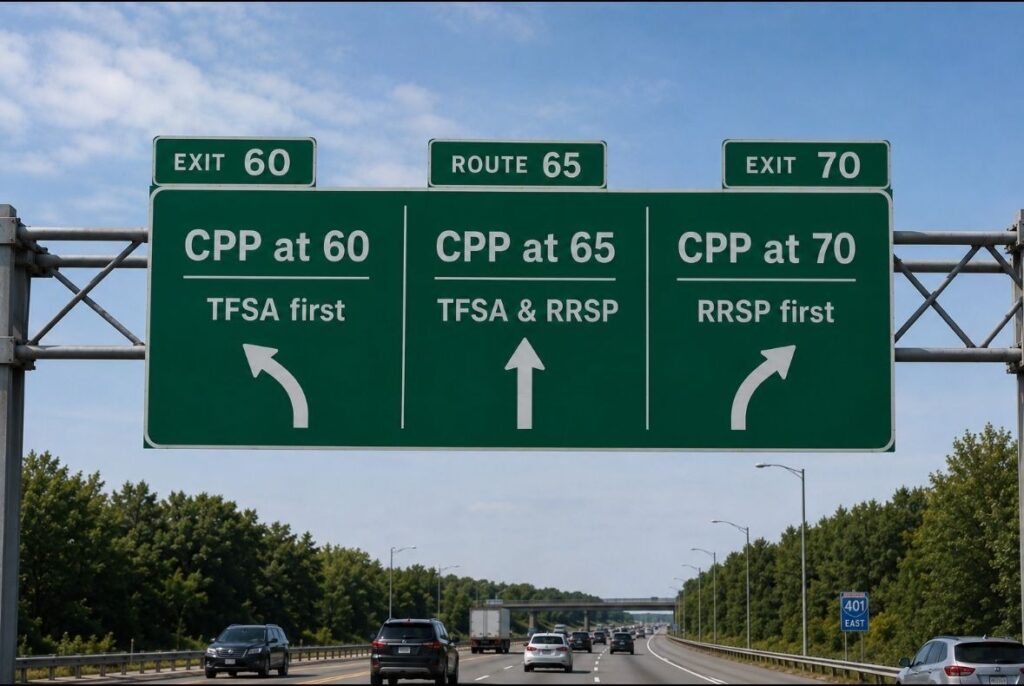
The conventional rule is: non-registered (open) first ? RRSP/RRIF next ? TFSA last. The logic is simple — keep your tax-sheltered accounts compounding as long as possible, and the TFSA is the most powerful shelter because growth and withdrawals are both tax-free.
But that rule is increasingly out of favor, and most planners myself included, now recommend some version of a blended drawdown in the years between retirement and age 71.
A few reasons:
The biggest risk with deferring RRSP/RRIF too long is that mandatory RRIF minimums (starting the year after you turn 71) plus CPP and OAS can shove you into a higher bracket than you were in pre-retirement, and potentially into OAS clawback territory (around $93k in 2026). Worse, on the second-to-die date, the entire remaining RRIF gets taxed as income in a single year — often at the top marginal rate. So front-loading RRSP withdrawals in your 60s, while your other income is low, can save real money over your lifetime and your estate’s.
The case for non-registered first still holds when you have meaningful unrealized capital gains, since gains are only 50% included (still, after the 2024 budget walkback below $250k) and eligible dividends get the dividend tax credit. But if your open account is mostly interest-bearing or already harvested, the tax advantage shrinks.
TFSA last still holds in most cases — it’s the only account where withdrawals don’t count as income, so they don’t affect OAS clawback, the age credit, or GIS. It’s also the best account to leave to a spouse (via successor holder) or to use for lumpy expenses like a new roof or a car that would otherwise force a big RRIF withdrawal.
A reasonable framework for someone retiring at 60–65: defer CPP and OAS to 70 if longevity supports it, draw RRSP/RRIF down to fill up the lower brackets (whatever keeps you under the OAS threshold and ideally in the 20–30% combined bracket), top up from non-registered as needed, and only touch the TFSA for one-off expenses or to avoid spiking into a higher bracket in any given year. Spouses with very different RRSP balances should also look at spousal RRSPs before retirement and pension income splitting after 65.
Most scenarios are a bit different, but this is the basis for the best taxable income.